Traditional IRA vs Roth IRA: Which Is Better for You?
The choice between traditional and Roth IRA determines whether you get a tax break now or in retirement. The right answer depends on your current versus expected future tax rate, your timeline, and factors beyond pure math including flexibility and estate planning goals.
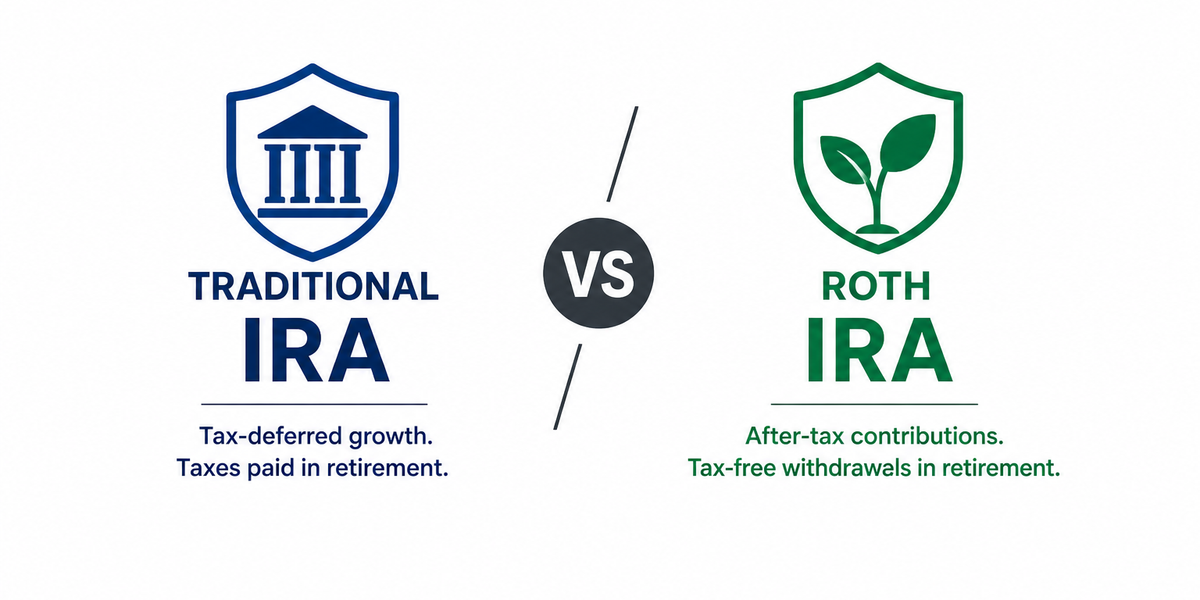
The traditional IRA versus Roth IRA question is one of the most frequently asked in retirement planning, and the honest answer is that it depends on your tax situation in a way that requires some analysis rather than a simple recommendation. Both accounts provide powerful tax advantages; they simply provide them at different points in time.
The traditional IRA deducts contributions from current taxable income, providing an immediate tax benefit, and taxes withdrawals in retirement as ordinary income. The Roth IRA provides no immediate deduction but allows all qualified withdrawals in retirement to be completely tax-free. The mathematically correct choice between them depends on whether you are in a higher tax bracket today (favoring traditional) or will be in a higher bracket in retirement (favoring Roth).
This guide explains both account types in detail, the factors that determine which is better for your situation, the non-mathematical factors that often tip the decision toward Roth, and how to access Roth benefits at any income level.
Traditional IRA: The Basics
A traditional IRA allows tax-deductible contributions, reducing your taxable income in the year of contribution, subject to income limits when you also have access to a workplace retirement plan. The money grows tax-deferred and withdrawals in retirement are taxed as ordinary income. Required minimum distributions begin at age 73.
For 2024, you can contribute up to $7,000 ($8,000 if 50 or older) to a traditional IRA. The deductibility of contributions phases out for single filers with workplace plan access at incomes between $77,000 and $87,000, and for married filing jointly between $123,000 and $143,000.
If you are not covered by a workplace plan, you can deduct traditional IRA contributions at any income level. If only your spouse is covered by a workplace plan, the phase-out for your deduction applies at married filing jointly income of $230,000 to $240,000.
| Feature | Traditional IRA | Roth IRA |
|---|---|---|
| Tax treatment | Deduct contributions now; pay taxes on withdrawals | No deduction now; tax-free withdrawals |
| Best if | Higher tax bracket now than in retirement | Same or higher tax bracket in retirement |
| Contribution limits | $7,000; $8,000 if 50+ | $7,000; $8,000 if 50+ (income limits apply) |
| Income limits | Deductibility phased out at higher incomes | Contributions phased out at higher incomes |
| RMDs | Required at age 73 | Not required during owner's lifetime |
| Withdrawal flexibility | 10% penalty before 59½ (exceptions apply) | Contributions can be withdrawn penalty-free anytime |
| Estate planning | Less favorable; heirs pay taxes | More favorable; heirs inherit tax-free |
Roth IRA: The Basics and Why It Often Wins
A Roth IRA accepts after-tax contributions, meaning you pay taxes on the money before contributing. The money then grows completely tax-free, and qualified withdrawals in retirement are also completely tax-free. There are no required minimum distributions during the account owner's lifetime.
Roth IRA eligibility phases out for single filers at incomes between $146,000 and $161,000 (2024), and for married filing jointly between $230,000 and $240,000. Above these thresholds, direct Roth IRA contributions are not allowed, though the Backdoor Roth IRA strategy provides access regardless of income.
The Roth IRA's flexibility advantage goes beyond the tax-free retirement income. Because contributions (not earnings) can be withdrawn at any time without taxes or penalties, the Roth IRA serves as a secondary emergency fund for people who need it. And because contributions are already taxed, they can be left to grow indefinitely without RMDs, making them the most valuable account to leave to heirs.
The Tax Rate Comparison: The Core of the Decision
The mathematically correct choice between traditional and Roth is determined by whether your current marginal tax rate is higher or lower than your expected marginal rate in retirement on additional income. If you are in the 24 percent bracket now and expect to be in the 12 percent bracket in retirement, traditional is better: you save 24 percent now and pay only 12 percent when you withdraw.
If you are in the 12 percent bracket now and expect to be in the 22 percent bracket in retirement (because RMDs from your 401k will push income higher), Roth is better: you pay 12 percent now and pay nothing in retirement.
The complication is that future tax rates are genuinely uncertain. Tax law changes constantly, current tax rates are scheduled to change after 2025 when current law sunsets, and your retirement income level is difficult to predict precisely. This uncertainty is one reason why tax diversification, holding both traditional and Roth accounts, is often recommended even when one appears mathematically superior.
Non-Mathematical Factors That Often Favor Roth
Flexibility is a significant Roth advantage that mathematical comparisons miss. Roth IRA contributions can be withdrawn at any time without penalty since they are already taxed. This makes a Roth IRA serve double duty as an emergency fund supplement that also grows tax-free for retirement. Traditional IRA withdrawals before 59½ are subject to a 10 percent penalty.
Estate planning strongly favors Roth. When you leave a Roth IRA to heirs, they inherit it tax-free. They must distribute the account within 10 years (under current law), but those distributions are also tax-free. Traditional IRAs left to heirs are subject to income tax as they are distributed. The after-tax value of a Roth IRA to heirs is significantly higher than an equivalent traditional IRA balance.
The uncertainty of future tax rates, combined with the flexibility and estate planning advantages of Roth, leads many financial planners to recommend Roth contributions even when the immediate tax comparison appears to favor traditional. Having both types provides the ability to manage taxes in retirement by choosing which account to draw from based on actual income in each year.
Final Thoughts
The traditional versus Roth IRA decision is genuinely individual, depending on your current and expected future tax rates, your need for account flexibility, your estate planning goals, and your confidence in predicting future tax law. When in doubt, the combination of tax diversification between both types provides the most resilient retirement income structure.
For most young workers in lower tax brackets, Roth is the clear winner. For higher earners in peak earning years, traditional often provides a more immediate tax benefit. For everyone approaching retirement with significant traditional IRA balances, Roth conversion planning to manage future RMDs deserves consideration.
Choose the account type that fits your tax situation. Revisit the decision annually. And if you are truly uncertain, hold both.
Frequently Asked Questions
Clarion Editorial Team
Editorial Research Team
Clarion Editorial Team creates plain-English educational content covering legal, insurance and finance topics for US and UK readers.
- Editorial Research
- Consumer Education
- Financial Literacy
Related Guides

401k vs IRA: Which Retirement Account Is Better?

529 College Savings Plans: A Complete Guide

Backdoor Roth IRA: How High Earners Can Access Roth Benefits
