Asset Allocation: How to Diversify Your Portfolio
Asset allocation is the single most important investment decision you will make, responsible for more of your long-term returns than any individual stock or fund pick. Understanding how to divide your portfolio across asset classes gives you the foundation of every sound investment strategy.
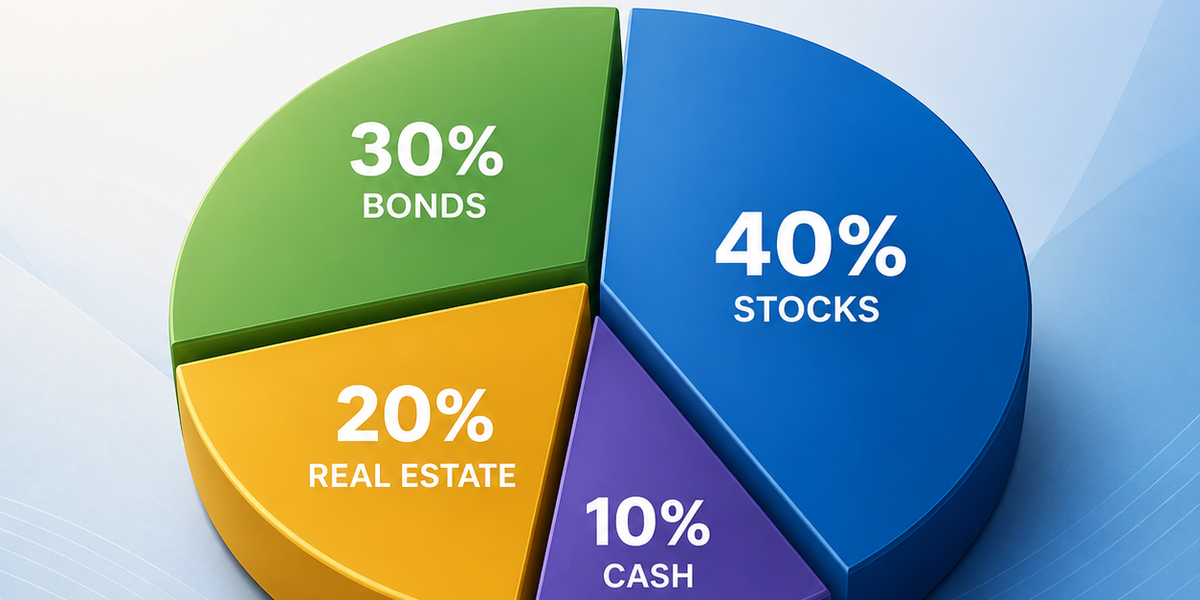
If you have ever spent time agonizing over which individual stock to buy while your overall portfolio mix went unconsidered, you have had your priorities backwards in the way that most investors do. Academic research consistently finds that asset allocation, the division of your portfolio across stocks, bonds, cash, and other asset classes, explains the vast majority of long-term investment returns and risk. The specific securities you pick within each class matter far less.
Asset allocation is not a set-it-and-forget-it decision, but it is also not a decision that requires constant adjustment. The right allocation is one that reflects your time horizon, your financial goals, and your genuine risk tolerance, meaning how you actually behave when markets fall rather than how you think you would behave in the abstract.
This guide explains the major asset classes, how to think about allocating among them, why the right allocation is different for every investor, and how to implement and maintain an allocation without overcomplicating the process.
The Major Asset Classes and What They Provide
Stocks, also called equities, represent ownership in companies and have historically provided the highest long-term returns of any major asset class. The S&P 500 has returned approximately 10 percent annually before inflation over long periods, though with significant year-to-year volatility. Stocks are appropriate for the growth portion of a portfolio and are most powerful when held over long time horizons that allow short-term volatility to smooth out.
Bonds, also called fixed income, represent loans to governments or corporations that pay interest over a specified period and return the principal at maturity. Bonds are generally less volatile than stocks and provide income and stability to a portfolio. In periods of market stress, bonds often rise in value as investors seek safety, partially offsetting stock losses. The trade-off is lower long-term expected returns than stocks.
Cash and cash equivalents, including money market funds, Treasury bills, and high-yield savings accounts, provide liquidity and capital preservation with minimal volatility. They are essential for short-term financial needs and emergency funds but erode purchasing power in inflationary environments over long periods. Alternative asset classes including real estate, commodities, and international investments add diversification beyond the standard stock-bond mix.
| Asset Class | Historical Return (approx) | Volatility | Role in Portfolio |
|---|---|---|---|
| US Stocks (large cap) | ~10% annual | High | Growth; long-term wealth building |
| International Stocks | ~7-8% annual | High | Geographic diversification |
| Bonds (investment grade) | ~4-5% annual | Low-moderate | Stability; income; buffer against stock losses |
| Real Estate (REITs) | ~8-9% annual | Moderate | Income; inflation hedge; diversification |
| Cash / Short-term | ~2-4% annual (current) | Very low | Liquidity; short-term needs; emergency fund |
| Commodities | Variable | High | Inflation hedge; diversification |
How to Think About Your Allocation
The starting point for determining your asset allocation is your time horizon, meaning how many years until you need to use the money. A 25-year-old saving for retirement has 40 years of investment time, during which the portfolio can absorb significant volatility because there is ample time to recover from downturns. A 65-year-old who will begin withdrawing from their portfolio in five years has a much shorter window for recovery and needs a more conservative allocation.
Risk tolerance is the second key dimension. Risk tolerance has two components: your financial capacity to absorb losses, which is objective and measurable, and your emotional tolerance for watching your portfolio decline, which is subjective and often misjudged until a real market drop reveals it. Many investors discover during their first significant bear market that their emotional risk tolerance is lower than they thought when markets were rising.
A simple rule of thumb that has been used for decades is to subtract your age from 110 or 120 to determine your stock allocation, with the remainder in bonds. By this formula, a 40-year-old would hold 70 to 80 percent stocks and 20 to 30 percent bonds. This heuristic is a starting point rather than a prescription, and your specific situation may call for a more aggressive or conservative allocation based on your goals, other assets, and risk tolerance.
Popular Allocation Models and When Each Makes Sense
Aggressive allocations, typically 90 to 100 percent stocks with 0 to 10 percent bonds, are appropriate for young investors with long time horizons, high income stability, and the psychological fortitude to watch their portfolio drop 40 to 50 percent in a bear market without panic-selling. The higher expected long-term return of this allocation comes with the highest short-term volatility.
Moderate allocations, typically 60 to 70 percent stocks and 30 to 40 percent bonds, represent the traditional balanced portfolio model. This allocation aims to capture most of the stock market's growth while the bond component moderates volatility and provides a source of funds to rebalance into stocks during downturns. The 60/40 portfolio has been the default recommendation for decades and remains a solid baseline for most mid-career investors.
Conservative allocations, with 40 to 50 percent stocks and 50 to 60 percent bonds or other stable assets, are appropriate for investors approaching or in retirement who need to draw income from their portfolios and cannot afford large drawdowns. The lower volatility comes at the cost of lower expected returns, which is an acceptable trade when capital preservation and income have replaced growth as the primary objective.
Implementing and Maintaining Your Allocation
Implementing your allocation is straightforward with modern investment accounts. A two-fund or three-fund portfolio using low-cost index funds, one total US stock market fund, one international stock fund, and one US bond fund, can implement virtually any target allocation with simplicity and minimal ongoing management. These funds are available at Vanguard, Fidelity, and Schwab at very low expense ratios.
Maintaining your allocation requires periodic rebalancing when market movements cause your actual allocation to drift from your target. If stocks have a strong year, your portfolio may shift to 75 percent stocks when your target is 70 percent. Rebalancing means selling some stocks and buying bonds to restore the target, which mechanically enforces buying low and selling high.
Annual rebalancing, or rebalancing whenever any asset class drifts more than 5 percentage points from its target, is a practical and research-supported approach that keeps the portfolio aligned with your risk tolerance without requiring constant attention or generating excessive transaction costs.
Final Thoughts
Asset allocation is the framework within which all other investment decisions operate, and getting it right matters more than any individual investment choice you will ever make. The right allocation is the one you can maintain through bull and bear markets alike because it reflects your genuine time horizon and risk tolerance rather than your aspirational one.
Implement your allocation with simple, low-cost index funds. Rebalance periodically. Adjust gradually as your life circumstances change. Avoid the temptation to dramatically shift your allocation in response to market events, which is almost always counterproductive.
The investors who build wealth are not those who find the hottest stock picks. They are those who define an appropriate allocation, implement it simply and cheaply, and maintain it patiently through all the market cycles that time produces.
Frequently Asked Questions
Clarion Editorial Team
Editorial Research Team
Clarion Editorial Team creates plain-English educational content covering legal, insurance and finance topics for US and UK readers.
- Editorial Research
- Consumer Education
- Financial Literacy
Related Guides

Best ETFs to Buy for Long-Term Growth

Bond Investing: What Bonds Are and How to Use Them

Compound Interest: The Most Powerful Force in Investing
